Should you invite the whole class to your child’s birthday party?
Updated October 2026
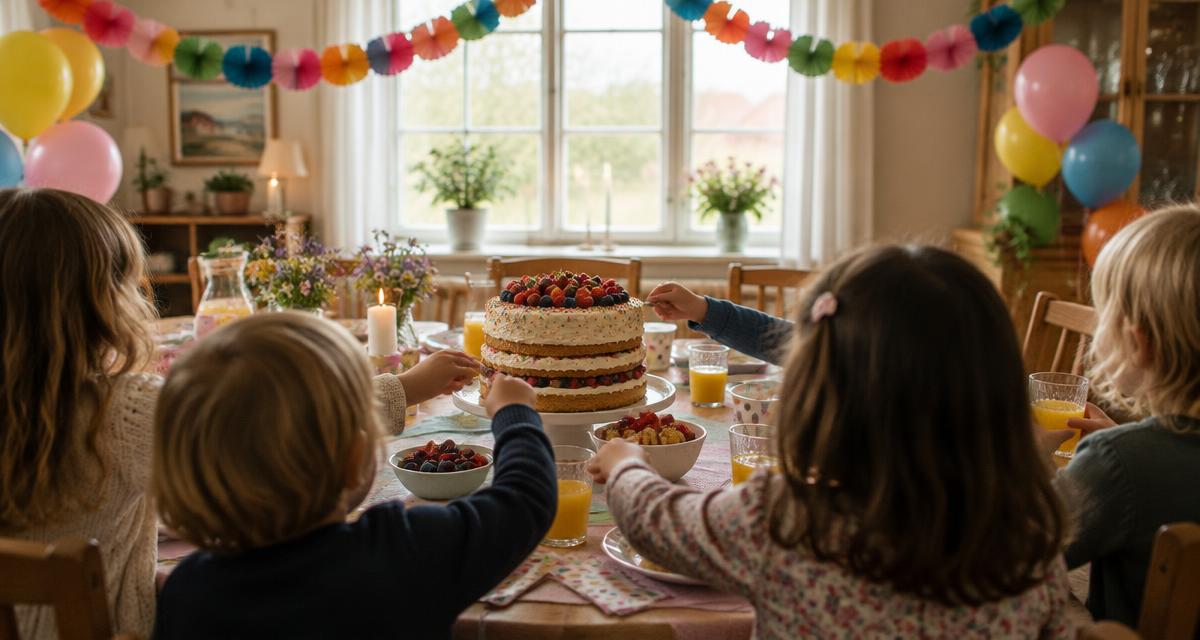
There is no rule that applies across Denmark. But your class will almost always have an agreement, and that is what matters.
Contents
- The question no one dares ask out loud
- There is no rule. There is an agreement.
- The three approaches
- How to find out what your class has agreed
- When you can’t invite everyone
- When you invite the whole class
- The practicalities of hosting lots of children
- Questions that often come up
- Here’s what the invitation looks like
- Make your own
The question no one dares ask out loud
Your child wants a birthday party. And straight away, the question comes up: do all 24 children have to come? Even the ones she never plays with? Even the boy who was unkind in the autumn?
You want to do the right thing. You just don’t want to be the parent who got it wrong, and you’re not entirely sure what the right thing is.
You’re not alone. It’s one of the questions parents in a class feel most uncertain about, and one of the least discussed.
There is no rule. There is an agreement.
Let’s clear this up first: there is no law or national rule in Denmark about who you must invite to a private birthday party. It’s your party, in your home, and the decision is yours.
But most schools and classes have an agreement made jointly by the parents, often at a parents’ meeting in the reception year or first year of Danish school. That agreement is not legally binding. It is an expectation. And it is why you can put a foot wrong without realising it.
These agreements are similar from school to school, but they are not identical. So the first step is always to find out what your class has agreed.
The three approaches
Almost every class agreement is a variation on these three.
The whole class. Everyone is invited, every time. This is the most common approach in the early school years, and the simplest socially, because no one can be left out. It does mean a big party, though, so most families hold it away from home.
All the boys or all the girls. The class is split by gender, and everyone in the relevant group is invited. This roughly halves the numbers while keeping the principle that no individual child is left out. It is common from around the second to fourth years of Danish school.
At least three or four. Some classes agree that you either invite a broad group or keep it very small: three or four friends. The thinking is that a small party with a handful of close friends does not feel selective in the same way as inviting eighteen out of twenty-four children.
All three approaches have the same aim: to avoid leaving one child as the only one who wasn’t invited.
How to find out what your class has agreed
Ask. That’s all there is to it, and it takes two minutes.
Message the class parent committee or parent representative before sending anything out: "Hi, Mathilde is having a birthday party in November. What’s our class agreement on who to invite?"
You can also ask the class teacher, who will usually know the agreement. And if there has never been one, that is useful to know too: there is no agreed approach, so you can do what you think best.
It is much easier to ask first than to put things right afterwards.
When you can’t invite everyone
Sometimes it just isn’t possible. The flat is too small, the budget won’t stretch to taking twenty-four children swimming, or your child feels strongly about what they want.
Two things make a big difference:
Be clear about the size of the party, not the people. "We’re having a small birthday party with four friends this year" is different from a list of who didn’t make the cut. The first is about the size of the party. The second is about the children.
Don’t send the invitation somewhere uninvited families can see it. This is where things most often go wrong. If you post in the shared thread on Aula, Denmark’s school–home communication platform, or in the class group chat, all the parents will read it, and their children will hear about it. Send it directly to the relevant parents instead.
And talk to your child about it. Children talk in the playground, and agreeing not to make a big thing of the party in front of those who aren’t invited helps more than anything else.
When you invite the whole class
Then the challenge is different: twenty-four children and twenty-four parents who need to receive the same message, reply to it, and remember the time and place.
This is where a message thread stops working. The invitation gets buried, replies come in from all directions, and you end up counting them by hand on Thursday evening.
Send a single link instead. Create the invitation in one place, then post a short message with the link on Aula. Parents tap it, watch the invitation open on their phone, and tap yes or no. They don’t need to download an app or create an account.
You can see at any time who has replied and who hasn’t, so you can remind the remaining parents individually rather than sending another message to the whole class.
We’ve explained how it works in practice here: An easy birthday invitation for Aula.
The practicalities of hosting lots of children
Once you have more than fifteen children coming, the party takes on a different feel. A few things are worth knowing in advance:
- Set a finish time and put it in the invitation. Parents plan their Saturday around it, and without one you’ll be asked twenty times.
- Say whether parents should stay or drop their children off. With lots of children, having five adults or twenty-five makes a real difference.
- Consider a venue away from home. Sports halls, swimming pools and indoor play centres cost more, but with twenty-four children they can often make the difference between a stressful day and an enjoyable one.
- Make a wish list. When the whole class comes, so do lots of presents, and without some coordination you may end up with three of the same thing.
- Give a reply-by date. Without a deadline, people never get round to replying.
Questions that often come up
Can I invite everyone except one child?
You can, but this is exactly what every class agreement is designed to prevent, and it causes the most hurt. If there is a genuine reason why inviting everyone isn’t possible, keep the party small rather than inviting almost everyone.
Are siblings invited?
Only if you say so. Make it clear in the invitation, otherwise half the parents will ask.
What do I do about people who never reply?
Set a deadline and send a personal reminder a couple of days before it. A direct message is much more likely to get a reply than another post to the whole class.
Should I invite the parents too?
In the early school years, parents often stay. From around the third year of Danish school, most drop their children off. Say what you expect in the invitation so no one has to guess.
What if my child isn’t invited to other children’s parties?
Talk to the class teacher or class parent committee if it keeps happening. This is exactly what class agreements are for, and it is easier to raise it as a general issue than as a specific accusation.
Here’s what the invitation looks like
This isn’t a screenshot. Tap it and watch the invitation open just as parents would see it.
Make your own
Choose a design, enter the name and date, and share the link wherever suits you: on Aula, by text or in the group chat.